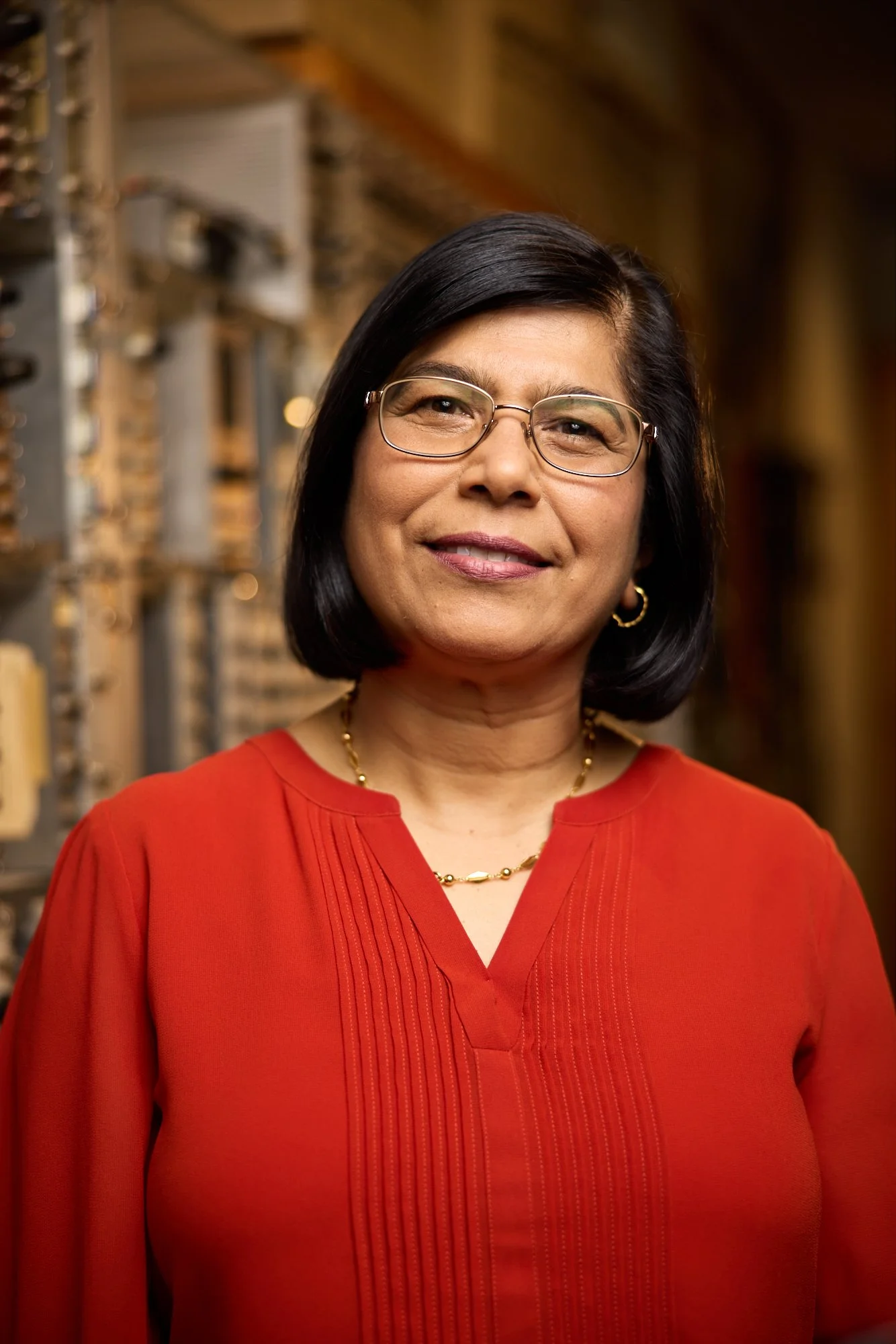
Prof Mahananda Dasgupta
Professor and Director, Heavy Ion Accelerator Facility, The Australian National University (ANU)
FAA FTSE FAPS FAIP
Department of Nuclear Physics and Accelerator Applications
Research School of Physics, The Australian National University
Director, Heavy Ion Accelerator Facility
Director, ARC Industrial Transformation Training Centre for Radiation Innovation
About Me and what I love about Physics
I am Mahananda Dasgupta and am originally from India. As a student, I loved studying mathematics and physics as they were logical and did not involve much memorising or drawing! A summer scholarship at the Tata Institute of Fundamental Research (TIFR) in Mumbai, India, introduced me to the fascinating world of research. I later returned to TIFR to do my PhD, before joining the Australian National University in 1992.
What I love most about experimental physics is the combination of human curiosity and creativity to solve problems. Designing experiments to test new ideas is both challenging and exciting as it requires scientific, technical and engineering expertise to be brought together to develop clever instruments that enable precision measurements. I am drawn to nuclear physics because it allows us to explore fundamental questions about nature while also contributing to solutions for immediate societal challenges. Working in diverse teams and seeing how ideas evolve through different perspectives is an aspect that I find most fascinating and rewarding.
My Path into Physics
My journey into nuclear physics was not planned. Growing up in India, I had imagined a career in the Indian Civil Service, hoping to contribute to society and make a change for the better. That changed when a vacation scholarship at the Tata Institute of Fundamental Research (TIFR) introduced me to particle accelerators and nuclear physics research. I found experimental physics addictive and great fun. I enjoyed building things, working with my hands, and solving challenging problems, so I decided to pursue a PhD instead.
That decision eventually brought me to Australia and the Australian National University in 1992. I had expected to stay for only two years, but more than three decades later I am still here. Along the way, I have learned that changing the world can take many forms, from advancing fundamental knowledge and developing new scientific capability to mentoring and supporting the next generation of scientists as they grow into leaders and contribute to society.
What I Work On
My research explores the invisible yet incredibly strong forces that shape our universe. At the heart of every atom is the nucleus, an extraordinarily small object. In fact, five billion atomic nuclei lined up side by side would be about the thickness of a human hair. Using the particle accelerator at the Australian National University, my team and I design experiments to understand how atomic nuclei interact. These interactions power the Sun, enable the creation of new elements and medical isotopes, influence extreme environments in space, and underpin technologies used in cancer treatment. Understanding this tiny quantum world benefits society. As we understand this fascinating tiny quantum world, we increase our ability to use it for research, applications and societal benefit.
Highlights & Milestones
e.g., major projects, discoveries, leadership roles, awards, outreach activities
Leading the ARC Industrial Transformation Training Centre in Radiation Innovation (RadInnovate), a partnership between Universities and industries to train PhD students in nationally important areas of nuclear and radiation science, policy and governance.
World-best precision measurements of nuclear fusion demonstrating that the increased quantum tunnelling results as the single energy barrier is effectively replaced by multiple barriers to fusion.
Member of the Prime Minister’s National Science and Technology Council (2024-2026), Elected Fellow of the Australian Academy of Science (AAS) and Fellow of the Australian Academy of Technological Sciences and Engineering (ATSE)
Developed and convened the unique Mentoring and Guidance in Careers (MAGIC) national 4.5-day residential workshop series for early-career women and gender-diverse researchers in science, together with Professor Nalini Joshi, as part of an Australian Laureate Fellowship.
Reflections
As I have progressed though my career, I have learned that creative thinking, people and team-work are at the heart of every success story. I have also learned the value of resilience. Research is full of setbacks, and being part of a minority can add further challenges. When I began in research, the culture was very different and far less diverse than it is today. As an Indian woman in physics, I sometimes found that my direct approach challenged expectations. These experiences reinforced the importance of creating supportive environments, and mentoring people so that everyone can thrive. What inspires me most is seeing talented people grow, succeed, and go on to make their own contributions. Of all my achievements, I am proudest of the people we have trained and mentored along the way